
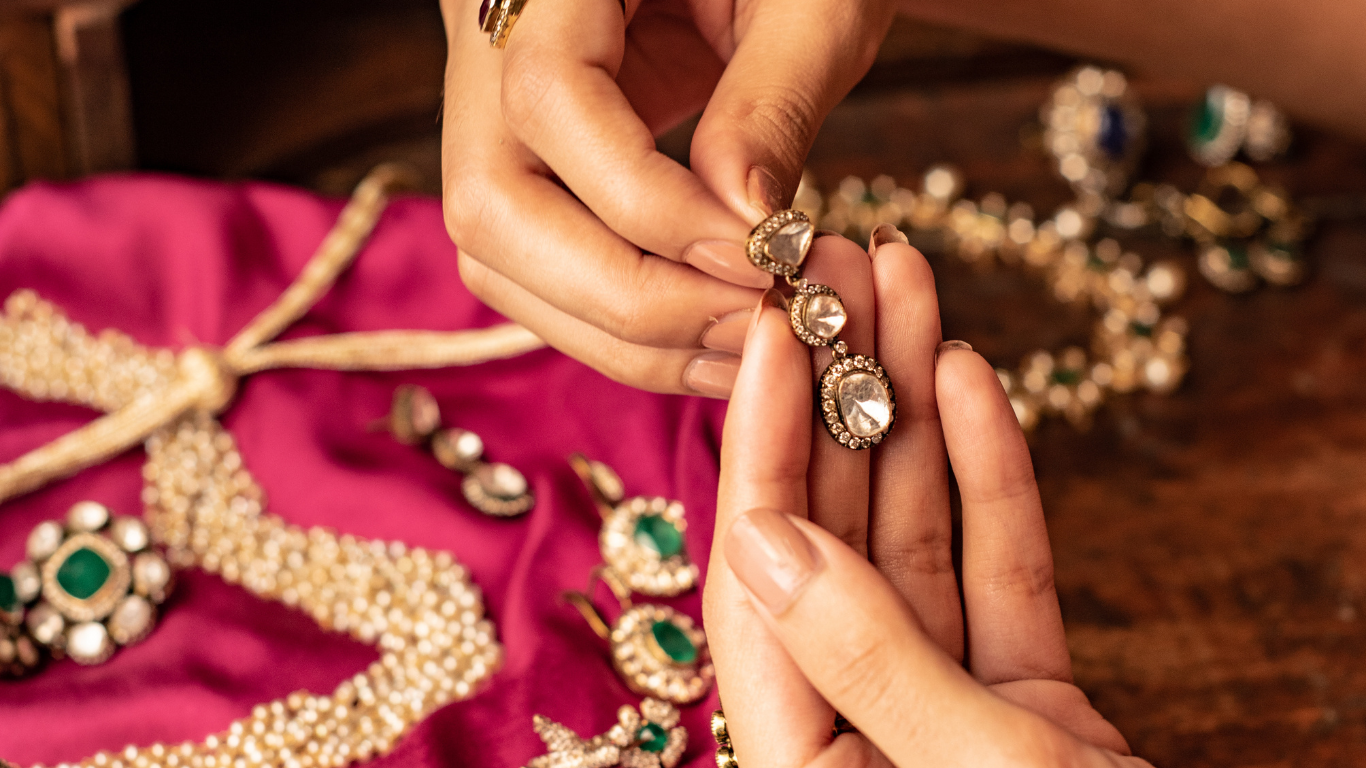
From the meticulous strokes of Takkar to the vibrant hues of Meenakari, each technique in Indian jewellery-making is a testament to centuries of craftsmanship, culture, and creativity.
India’s jewellery heritage is as diverse and intricate as its culture.
Each piece not merely an accessory, but a work of art born from centuries-old techniques. In this blog, we delve into the infamous arts of Takkar, Partash, Badroom, Meenakari, and the process of Khudai, each a celebration of craftsmanship, tradition, and timeless elegance.
Takkar ka Kaam
The power of precision
The exquisite art of setting gemstones without any visible prongs or metal, creating a seamless surface of brilliance. Each stone is meticulously cut to slide into a hidden gold rail beneath, showcasing over hours of craftsmanship.
Steps-
- Gemstones that are perfectly color-matched are collected
- Gemstones are cut so as to fit snugly against each other, the girdle of one stone pressed against the girdle of its neighbor, with very minute grooves cut just below the girdle.
- Channels of metal are made, usually in gold
- The gemstones are either slid or individually placed within the grooves.

Partash ka Kaam
Beauty behind the scenes
The process begins with designing the piece, followed by carving intricate patterns on the gold surface. These grooves are then filled with lac, and gemstones and diamonds are inlaid, often surrounded by Kundan (gold foil)
Steps-
- The process starts with a detailed design, which can be done by hand and is done on the purest form of gold.
- The design is then carved onto the gold using hand tools, creating intricate grooves and patterns.
- The carved grooves are filled with lac, a natural resin, to create a base for the other elements.
- Gemstones and diamonds are carefully inlaid into the lac-filled grooves, adding sparkle and color to the piece.
- Kundan (gold foil) is used to further enhance the design and secure the gemstones. It's meticulously placed around the stones and worked into the gold setting.

Badroom ka Kaam
Technique that speaks
The process of creating badroom Polki jewelry involves setting uncut diamonds (Polkis) into a delicate, jaali-like or tulle pattern using 24-karat gold. This intricate technique allows light to pass through multiple angles, enhancing the Polki's natural brilliance.
Steps-
- Polki diamonds, which are natural, uncut diamonds, are chosen for their unique shapes and characteristics.
- A framework, often resembling a jaali (lattice) or tulle pattern, is created using gold.
- Polki diamonds are carefully placed and secured within the gold framework, often packed closely together.
- The jaali structure allows light to interact with the Polkis from various angles, maximizing their natural shine and brilliance.
- The piece may undergo further detailing, such as the application of enamel or the addition of other gemstones.

Art of Meenakari
Essence of Indian Jewellery
Meenakari, involves applying vibrant colors onto a metal surface, usually gold by creating a design in the form of depressions, filling them with colored enamel, and then firing the piece to fuse the enamel to the metal.
Steps-
- A metal sheet, often gold, is shaped into the desired form.
- The design is engraved onto the metal surface, creating a pattern of depressions that will hold the enamel. This is typically done by a designer called a "naqqash".
- The enamel, which is powdered colored glass, is prepared by crushing glass and mixing it with a liquid, often made from pomegranate seeds and water, to create a paste.
- The enamel paste is carefully applied to the engraved design using a fine brush. Multiple layers and colors are applied, depending on the design.
- The enamelled piece is then fired in a furnace at a high temperature The heat melts the enamel, fusing it with the metal.
Experience the art of Meenakari through our handcrafted pieces at Sutra

Process of Khudai
Carving Culture by Hand
It refers to the engraving process where intricate designs are etched onto the metal surface. This technique is a crucial step in the meenakari process, creating spaces for the colorful enamel to be applied.
Steps-
- An initial design is sketched onto the metal surface, often using a pencil and compass for accuracy.
- Skilled artisans use sharp metal tools to carefully carve out the design, creating grooves and depressions.
- The engraving process creates hollows or cavities within the metal, which will later hold the enamel.
- These engraved areas are then ready to receive the enamel, which will be fused onto the metal through heating.

At Sutra, we celebrate this rich heritage by bringing these timeless arts into contemporary form, allowing you to not only admire their beauty but also wear a piece of history.
Let each piece tell a story, crafted by hand, rooted in tradition, and designed for today.

Leave a comment
This site is protected by hCaptcha and the hCaptcha Privacy Policy and Terms of Service apply.